

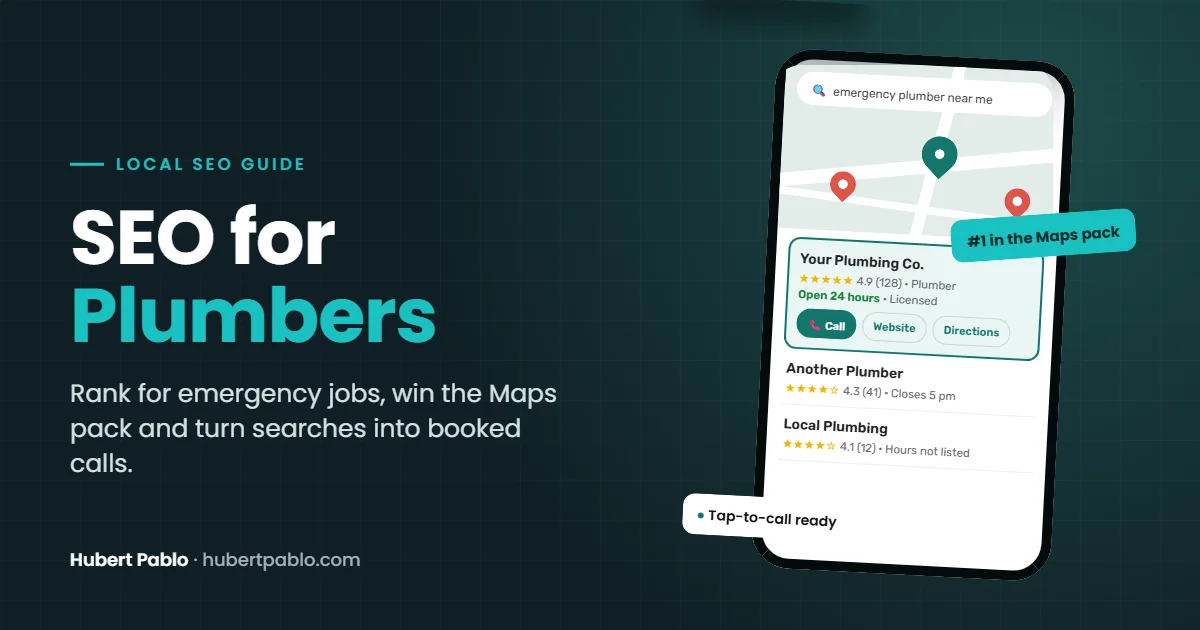
When someone’s hot water dies at 6am or a pipe bursts under the kitchen sink, they don’t scroll through ten pages of Google. They pick from the three businesses in the map, or the first plumber whose site makes it easy to call. That’s what SEO for plumbers comes down to: being one of those first few options, and making the call easy once someone lands on your site.
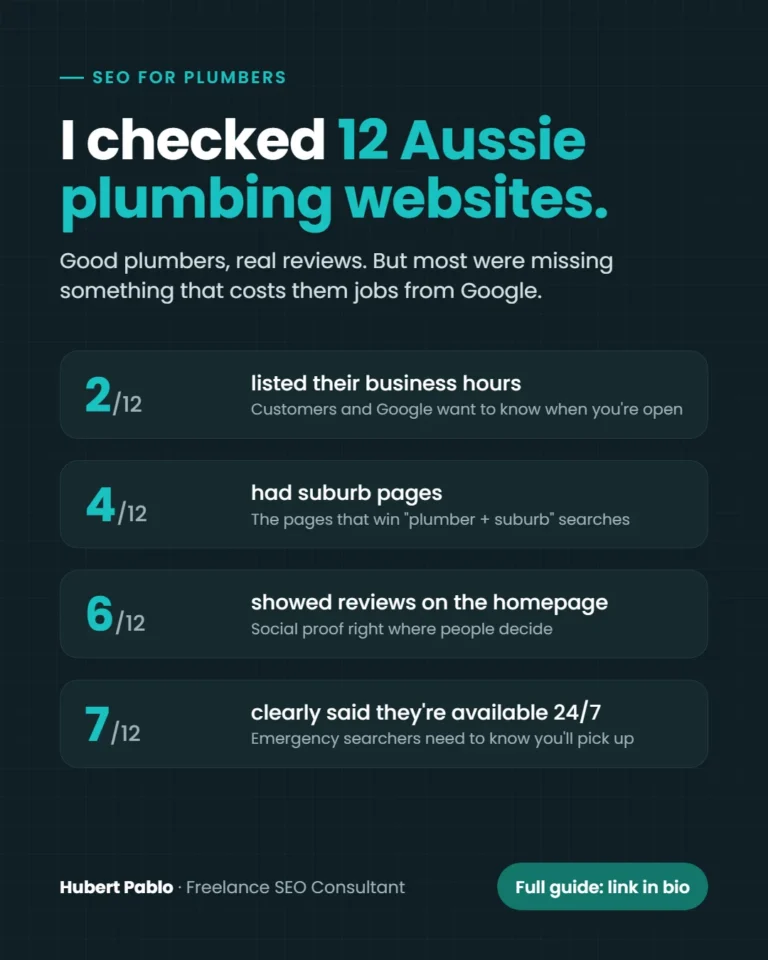
Before writing this, I looked at the homepages of 12 plumbing businesses across Melbourne, Sydney, Adelaide, Newcastle, Launceston, Port Macquarie and Gladstone. Most of them are good plumbers with real reviews. Most of them are also missing at least one thing that costs them jobs from Google. I’ll share what I found as we go, then walk through the seven steps I’d follow to fix it. The same steps work for electricians and most other tradies, which makes plumber SEO a good template for SEO for tradies in general.
In This Guide
Plumber SEO Audit: What I Found on 12 Australian Plumbing Websites
I checked each homepage for the basics a customer looks for in the first few seconds, and the basics Google uses to understand a local business.
| What I checked | Sites that had it | Why it matters |
|---|---|---|
| Phone number you can tap to call | 11 of 12 | On mobile, a number that isn’t tappable is a lost emergency job |
| Clear 24/7 or emergency availability | 7 of 12 | Emergency searchers need to know you’ll pick up right now |
| Actual business hours listed | 2 of 12 | Customers (and Google) want to know when you’re open |
| Separate page for each main service | 8 of 12 | One page can’t rank for drains, hot water and gas all at once |
| Individual suburb pages | 4 of 12 | Suburb pages help you show up for “plumber + suburb” searches |
| Reviews or testimonials on the homepage | 6 of 12 | Social proof right where people decide |
| Licence number shown | 7 of 12 | A quick trust signal, and in most states it’s expected |
The pattern was clear. The strongest sites had dedicated service pages, suburb pages, a Google rating on the homepage and a licence number in the footer. The weaker sites were often single-page brochures: a nice photo, a list of services and a phone number.
None of this is hard to fix. It just takes someone deciding to fix it. Good SEO for plumbers starts with these basics, long before you think about blogs or backlinks.
Step 1: Understand How People Search for a Plumber
The first step in SEO for plumbers is knowing how your customers search. Plumbing searches split into two very different moods, and your website needs to handle both.
Emergency searches are short and urgent: “emergency plumber near me”, “blocked toilet plumber”, “burst pipe”. These people are stressed and on their phone. They mostly pick from the Google Maps results and call the first business that looks trustworthy and available.
Planned searches are slower: “hot water system replacement cost”, “bathroom renovation plumber”, “gas heater installation”. These people compare two or three websites, read reviews and look at prices before they call.
Here’s how to match each type of search to the right page:
| Search type | Example search | Page that should rank | What the page needs |
|---|---|---|---|
| Emergency | “emergency plumber near me” | Google Business Profile and homepage | 24/7 hours, tap-to-call button at the top |
| Service | “hot water system replacement” | Hot water service page | Brands you install, rough price guide, recent jobs |
| Suburb | “plumber Geelong West” | Suburb page | Jobs done in that area, local reviews |
| Research | “why is my drain gurgling” | Blog post | A clear answer, then an easy way to book |
If you only have a homepage, you’re asking one page to do all four jobs. It won’t.
Step 2: Optimise the Google Business Profile Settings Plumbers Get Wrong
In SEO for plumbers, nothing moves the needle faster than your Google Business Profile. For emergency work, it matters more than your website. It’s what shows in the map pack, and for a lot of people it’s the only thing they look at before calling.
These are the settings I see plumbers get wrong most often:
Primary category. Set it to “Plumber”. Then add secondary categories that match real services, such as “Gas installation service”, “Drainage service” or “Water heater installation”. Don’t add categories for work you don’t do.
Hours. If you take emergency calls around the clock, set your hours to “Open 24 hours”. If you don’t, list your real hours and mention after-hours call-outs in your description. Only two of the 12 sites I checked listed their hours at all, so this alone can set you apart.
Service area. If you work from home and travel to customers, set up as a service-area business and hide your home address. Add the suburbs and towns you actually cover.
Business name. Use your real business name. Adding keywords like “Best 24/7 Emergency Plumber Melbourne” to your name breaks Google’s guidelines and can get your profile suspended. You can read the rules in Google’s guidelines for representing your business.
Services list. Add each service with a short description. This gives Google more detail about what you do.
Photos. Upload real photos of your van, your team and finished jobs. Stock photos don’t build trust.
Step 3: Get the Plumber SEO Basics Right on Your Website
Before adding new pages, make sure your site isn’t working against you. This part of plumber SEO is easy to overlook because it’s not visible, but it affects every page.
- Mobile first. Most emergency searches happen on a phone. Open your site on your own phone and check that the phone number is tappable, the text is readable without zooming, and the call button doesn’t hide behind a pop-up.
- Speed. A slow site loses people who are standing in a flooded laundry. Compress large photos, remove sliders you don’t need, and test your pages with Google’s free PageSpeed Insights.
- HTTPS. Your address should start with https and show the padlock. Browsers warn people away from sites that don’t.
- Name, address and phone number (NAP). Use exactly the same business name, address and phone number on your website, your Google profile and directories like Yellow Pages, hipages and True Local. Mismatched details confuse Google.
- Call tracking. Set up a way to count calls and form enquiries from your website, so you can tell which pages bring in jobs. Without it, you’re guessing.
- Local business schema. Ask your web developer to add LocalBusiness (Plumber) structured data with your name, phone, hours and service area. It helps Google read your details correctly.
Step 4: Build Service Pages for Blocked Drains, Hot Water and Gas Fitting
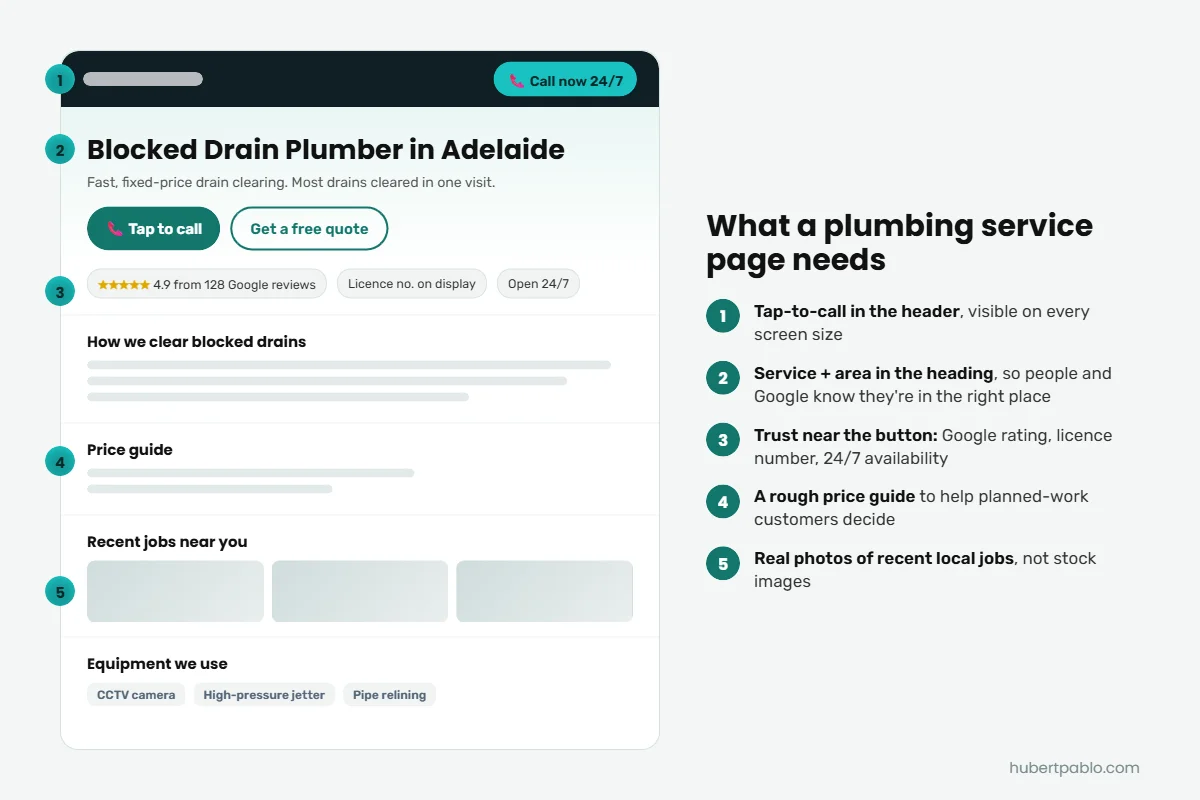
Service pages are the backbone of SEO for plumbers. Each main service you offer should have its own page. A customer searching “blocked drain plumber” wants to land on a page about blocked drains, not a homepage that mentions drains in a list of twenty things.
A good plumbing service page includes:
- A clear heading that says the service and area, like “Blocked Drain Plumber in Adelaide”.
- A tap-to-call button near the top, plus a quote form.
- What the job involves, in plain language. How you find the blockage (CCTV camera, jetter), what usually causes it, and how long it takes.
- A rough price guide if you can give one. Even “most blocked drains are cleared in one visit, starting from a set call-out fee” helps people decide.
- Brands you work with, especially for hot water (Rheem, Rinnai, Dux, Bosch and so on). People search for these brand names.
- Photos and a short example of a recent job.
- Your licence number and reviews, close to the call button.
Start with the services that bring in the most work or the most profit. For most plumbers that’s emergency plumbing, blocked drains, hot water and gas fitting. Add more pages later for things like leak detection, pipe relining, backflow testing or bathroom renovations.
Step 5: Create Suburb Pages for Local SEO That Don’t Look Like Copies
Suburb pages help you show up when someone searches “plumber Cranbourne” or “plumber Brighton”. Only four of the 12 sites I checked had them, and all four also had a separate page for each service.
The mistake to avoid is making 30 identical pages where only the suburb name changes. Google treats those as doorway pages, which are against its spam policies. They rarely rank, and they can drag the rest of your site down.
A suburb page is worth having when it includes things that are actually specific to that area:
- Jobs you’ve done there, with a photo and a sentence or two about each
- Reviews from customers in that suburb
- Local details that affect plumbing, like older homes with clay sewer pipes, hard water, or a lot of new estates
- Your travel time or response time to that area
Start with the five to ten suburbs where you already get the most work. A handful of good suburb pages beats fifty thin ones.
Step 6: Collect Reviews and Real Job Photos
Reviews are one of the strongest signals in SEO for plumbers, and they do two jobs. They help you rank in the map pack, and they’re what people read before deciding which of the top three plumbers to call.
A few things that work well:
- Ask at the right moment. The best time is right after you’ve fixed the problem and the customer is relieved.
- Make it easy. Send a text with your direct Google review link. Most people won’t go looking for it.
- Reply to every review, good and bad. A calm, professional reply to a negative review often builds more trust than another five-star one.
- Show reviews on your website. Half of the sites I checked had no reviews or testimonials on the homepage, which is a missed chance to build trust where people decide. (Health clinics are the exception: here’s why clinics can’t do this.)
Don’t offer discounts or freebies in exchange for reviews, and don’t only ask happy customers. Google doesn’t allow either.
For photos, before-and-after shots of real jobs are gold. A cleared drain on a CCTV screen, a new hot water unit installed neatly, a tidy gas fitting. Use them on your Google profile, your service pages and your suburb pages.
Step 7: Earn Local Links That Help Plumbers Rank
Links from other websites still matter in SEO for plumbers, but for a plumber the best ones are local and relevant, not bought in bulk.
- Suppliers and manufacturers. Many hot water and fixture brands list accredited installers on their websites. If you’re accredited, ask to be listed.
- Trade associations. Membership pages for your state’s master plumbers association are a strong, relevant link.
- Local sponsorships. Junior sports clubs, school fetes and community events often thank sponsors with a link.
- Builders and real estate agents you work with. A “preferred trades” page on a local builder or property manager’s site is worth more than fifty random directory links.
- Local news. Helping out after a storm or flood, or giving seasonal advice like protecting pipes in a cold snap, can get you mentioned in local news sites.
Stay away from cheap link packages. They rarely help local rankings and can get your site penalised.
How Long Before SEO for Plumbers Pays Off?
It depends on where you’re starting and how competitive your area is. A plumber in a regional town can often move faster than one in inner Sydney, where dozens of businesses compete for the same map spots.
As a rough guide, this is what I usually see:
| Timeframe | What’s happening | What you’ll notice |
|---|---|---|
| Month 1 | Google Business Profile fixed, technical issues sorted, tracking set up | Often a lift in calls from your Google profile |
| Months 2–3 | Service pages built or improved, reviews coming in steadily | Rankings start moving for service searches |
| Months 3–6 | Suburb pages, local links, ongoing reviews | Steady growth in map pack visibility and website enquiries |
| 6 months+ | Content and links keep compounding | More of your work comes from Google instead of paid lead sites |
With SEO for plumbers, most clients see measurable movement within three to six months. Brand-new websites usually take longer, because Google has no history to go on yet. There’s more on that in my SEO FAQ.
SEO for Plumbers: Frequently Asked Questions
How much should a plumber spend on SEO?
It depends on how many suburbs you want to cover and how much competition you have. A small local plumber can make real progress with plumber SEO on a modest monthly budget focused on their Google profile, a few service pages and reviews. If you’re comparing options, I’ve put together a breakdown of what SEO costs with an agency vs an independent consultant, including my own starting price.
Is Google Ads or SEO better for plumbers?
They do different jobs. Google Ads gets your phone ringing straight away, but the calls stop when you stop paying. SEO takes a few months to build, but the calls keep coming without paying for every click. Many plumbers use ads for emergency work while their SEO builds, then cut back on ads once they’re ranking well in the map pack.
How do I get my plumbing business on Google Maps?
Create or claim your Google Business Profile, verify it, choose “Plumber” as your primary category and fill in every section: hours, services, service area, photos and description. Then keep collecting reviews. Verification and ranking are two different things, so being on the map doesn’t mean you’ll be in the top three straight away.
Should I create a page for every suburb?
No. Create pages for the suburbs where you do the most work and can write something useful and specific about each one. Copy-paste suburb pages are more likely to hurt you than help.
Do I need a website if I have a Google Business Profile?
You can get calls from your Google profile alone, but a website helps you rank higher in the map pack and win the bigger planned jobs like hot water replacements and renovations. It’s also the one marketing asset you fully own.
SEO for Plumbers: The Short Version
SEO for plumbers isn’t about tricks. Get your Google Business Profile right, give each main service its own page, build a few suburb pages that are actually about those suburbs, and keep the reviews coming. Most of the plumbing sites I looked at were missing at least one of those, which means there’s room to get ahead of your competitors.
Want to Know What’s Holding Your Plumbing Website Back?
If you’re not sure where your website stands, I’ll take a look. I offer local SEO services for trade businesses, and every project starts with a free review. Get a free audit of your plumbing website and I’ll show you what’s stopping you from ranking, what to fix first and which quick wins are worth doing now.
I’ve been doing SEO for more than 18 years, including for home improvement brands, and you’ll work with me directly. You can read more about my background or see my SEO case studies.
Found this useful?
Add me as a preferred source on Google to see more of my SEO and AI search insights in your results.