

If you’ve had an SEO pitch in the last year, you’ve probably heard the terms AEO and GEO, often with a suggestion that your current SEO is out of date. I understand why business owners are confused. Google’s AI Overviews now sit above the results for a lot of searches, AI Mode has been live in Australia since October 2025, and plenty of customers ask ChatGPT for a recommendation before they open Google at all.
I started doing SEO in 2008. Since then I’ve worked through Panda and Penguin, the rise of featured snippets, the voice search hype and now AI answers, and each one came with a claim that SEO was finished. This article is my honest take on GEO vs SEO vs AEO: what each term means, what has genuinely changed, and what is the same work under a new name.
In this guide
What Is AEO, What Is GEO, and How Do They Compare to SEO?
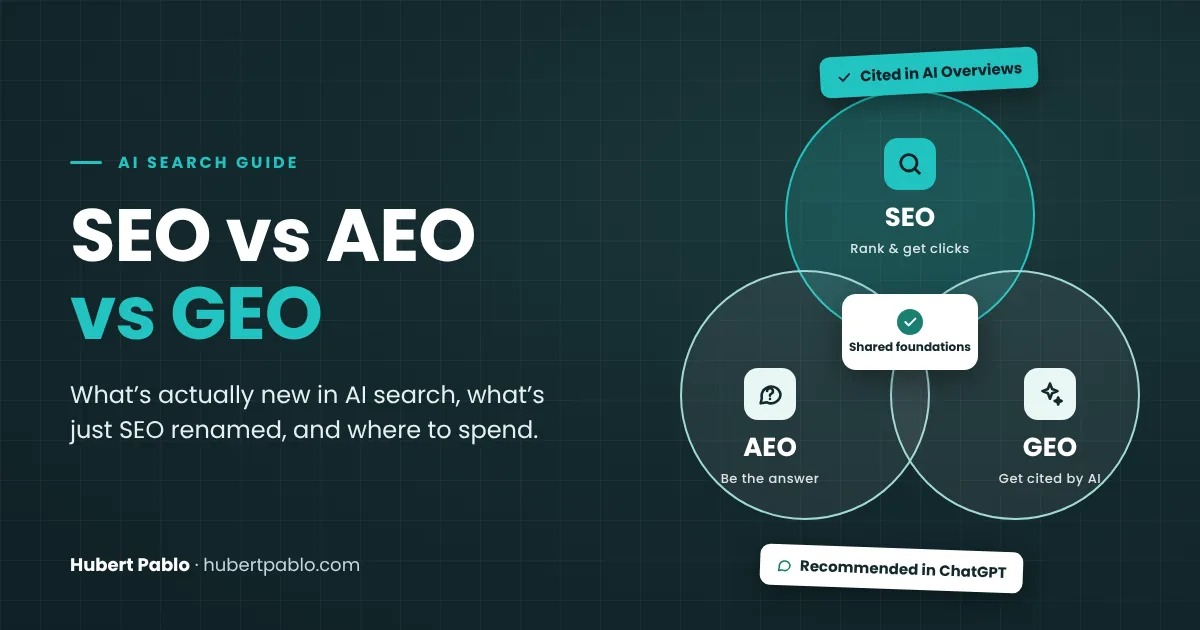
SEO (search engine optimisation) is getting your pages to rank and earn clicks in Google and Bing.
AEO (answer engine optimisation) is about being the answer itself, rather than one of ten blue links. That means featured snippets, People Also Ask boxes, voice answers and, more and more, being one of the sources Google cites in an AI Overview.
GEO (generative engine optimisation) is about being mentioned or cited when an AI tool writes an answer: ChatGPT, Gemini, Perplexity, Microsoft Copilot or Google’s AI Mode.
My short answer on GEO vs SEO: for Google, AEO and GEO are mostly SEO, and Google says as much in its own documentation. Outside Google, GEO adds one thing that really is different. What the rest of the web says about your business carries more weight than it does in normal rankings. That deserves attention. It doesn’t need a separate agency or a new budget line.
GEO vs SEO vs AEO at a Glance
This is the GEO vs SEO vs AEO comparison I sketch for clients when the question comes up.
| Aspect | SEO | AEO | GEO |
|---|---|---|---|
| Goal | Rank and earn clicks in search results | Be the direct answer to a question | Be cited or recommended inside AI-generated answers |
| Where it shows | Google and Bing results, Google Maps | Featured snippets, People Also Ask, AI Overviews, voice assistants | ChatGPT, Gemini, Perplexity, Google AI Mode, Copilot |
| What earns visibility | Relevance, quality, links, technical health | Clear answers on crawlable, indexed pages | The same foundations, plus consistent mentions of your brand on trusted sites |
| How it’s measured | Rankings, clicks and conversions (Search Console, GA4) | Snippet ownership and AI Overview citations | Prompt checks, AI referral visits in GA4, brand mentions |
| Needs separate work? | Core work | Mostly no. Google uses the same fundamentals | Partly. Off-site reputation and PR matter more |
Answer Engine Optimisation and GEO: What Google Says
You don’t need to take my word for any of this. Google published a guide called Optimizing your website for generative AI features on Google Search, and its position on answer engine optimisation and GEO is clear: optimising for AI Overviews and AI Mode is SEO.
To appear in those features, a page has to be indexed and eligible to show in normal search with a snippet. There’s no separate AI index to apply for. Google also says its Search doesn’t use llms.txt files, “AI text files” or Markdown copies of pages, so they won’t help or hurt you there. Structured data isn’t required for AI features either, although it’s still worth adding where it earns a rich result.
The guide also says you don’t need to break pages into small “chunks” or rewrite them for AI models, and it warns against churning out pages to chase AI queries. What it does recommend is unique, first-hand, helpful content, plus a Merchant Center feed if you sell products and a complete Google Business Profile if you serve a local area.
So if someone offers you an “AEO package” that is mostly special files, extra schema and rewritten content blocks, it’s fair to ask what it will change in Google, given Google has said it doesn’t need them.
AEO vs SEO: Where AI Search Really Differs
None of that means nothing has changed. When I look at AEO vs SEO and GEO vs SEO in real client work, three differences matter in practice.
1. Being cited matters, not just ranking
When an AI Overview shows up, fewer people click anything. Seer Interactive tracked 53 brands from January 2025 to February 2026, and Search Engine Land reported organic click-through rates of about 3.3% on searches without an AI Overview, about 2.1% when the brand’s page was cited in the Overview, and about 0.9% when it wasn’t. Ranking on page one is still what gets you considered. On searches with an Overview, though, the cited pages keep a much bigger share of the clicks that are left.
2. LLM SEO: ChatGPT and Perplexity don’t work like Google
ChatGPT answers partly from what it learned in training and partly from live web results when it searches. Perplexity searches the web for nearly every answer and lists its sources. Copilot relies on Bing. That’s why LLM SEO, or GEO for these tools, isn’t only about your own website. Reviews, directories, industry associations, local news and other people’s articles all shape what these tools “know” about your business.
3. Measurement is messier
With classic SEO you get rankings, clicks and conversions. AI visibility is harder to see. In June 2026 Google started testing a Search Console report for AI features, but it shows impressions only, with no clicks or queries, and it went to a subset of UK sites first. For most Australian businesses right now, measuring AI visibility means checking prompts yourself and tracking visits from chatgpt.com, perplexity.ai and gemini.google.com in Google Analytics 4.
What I Changed in My Own Client Work (and What I Didn’t)
AI search has changed a few parts of how I work. Most of it hasn’t moved.
What changed
I now check how AI tools describe a business before I recommend anything. I ask ChatGPT, Gemini, Perplexity and Google about the business and its category, then note what they get right, what they get wrong and which competitors they suggest instead. It’s a quick check, and it often turns up problems a normal audit misses, like an old address or a service the business stopped offering years ago.
When an AI tool has something wrong, the fix is usually on the sites it’s reading rather than on the client’s own website. That means business profiles, directories, review sites and the brand’s About and contact pages. Keeping the name, services, locations and proof points consistent everywhere has gone from a tidy-up job to a priority. I did the same for myself with a page that sets out verified facts about my work, so AI tools have one clear, accurate source to draw on.
I’ve also become even stricter about pages that answer one question well. A page with a clear answer near the top is easier for Google to show as a snippet and easier for an AI tool to quote.
What didn’t change
Technical SEO, on-page work, link building, local SEO and honest reporting are still the core of what I do. An AI tool can’t cite a page Google can’t crawl, and it won’t recommend a brand nobody else mentions. When I led the SEO on Mearth’s move from WordPress to Shopify, the work that kept its traffic growing was redirects, site structure and content, not anything AI-specific. That same groundwork is what gets a business into AI answers today. You can see the numbers in my case studies.
Is SEO Dead? What 18 Years of “SEO Is Dead” Has Taught Me
From 2012 to 2016 I worked on link building for William Hill, in online gambling, one of the most link-spammed industries in search. That was right through the Penguin years, when plenty of people said SEO was over because the shortcuts stopped working. The programs built on real, relevant links kept growing. William Hill’s organic traffic grew 3.1x over those four years.
AI search feels similar to me. Search engines keep getting better at working out what people actually trust, and AI tools are the next step in that direction rather than a reset. The shortcuts lose value, and the basics keep compounding.
Some things have changed for real, though. Simple “what is” questions that an AI can answer in a sentence send fewer clicks than they used to, and I wouldn’t build a content plan around them any more. Searches where someone needs to compare, book, buy or hire still send people to websites, and for most businesses that’s where the money is anyway.
Do You Need an AEO or GEO Agency, or Just Better SEO?
For most small and mid-sized Australian businesses, the GEO vs SEO question has a simple answer: good SEO that already takes AI search into account, not a separate AEO or GEO provider. Here’s how I’d decide.
If the basics aren’t done yet, such as a slow site, thin service pages, a half-finished Google Business Profile or only a handful of reviews, start there. AI tools lean on exactly those things.
If you already rank well but AI tools describe you wrongly or keep recommending competitors, that’s where GEO work earns its keep, mostly by cleaning up and building your presence on the sites those tools read.
And if someone pitches AEO as a bundle of special files and markup, ask them to explain what it will change in Google, given what Google has published.
Checking how ChatGPT, Gemini and Google’s AI Overviews describe a business is part of my AI SEO services, and the groundwork behind it is covered in my SEO services that include AEO and GEO.
SEO, AEO and GEO: Frequently Asked Questions
AEO vs SEO: is AEO different, or the same thing?
For Google it’s largely the same work. AEO focuses on answer-style results like featured snippets, People Also Ask and AI Overviews, but the pages that earn them are the same well-built, indexed pages that rank. Google’s guidance is that no separate techniques are needed for its AI features.
GEO vs SEO: which should a small business invest in first?
SEO first. GEO builds on the same foundations: a fast, crawlable site, strong service pages, a complete Google Business Profile and genuine reviews. Once those are in place, GEO work on your wider web presence makes them go further. Doing GEO without the SEO basics is like advertising a shop that’s hard to find.
What does GEO stand for in marketing?
Generative engine optimisation: improving how often and how accurately AI tools like ChatGPT, Gemini and Perplexity mention or cite your brand. The term comes from a 2023 academic research paper and has spread quickly through the marketing industry since.
Do I need to hire a GEO agency for my business?
Usually not as a separate provider. If your SEO consultant or agency already checks how AI tools describe you and works on your presence beyond your own website, you’re covered. A specialist only makes sense once the basics are in place and AI visibility is clearly the gap.
Will AI search replace Google?
Not any time soon. Google is itself one of the biggest AI search products, through AI Overviews and AI Mode. People increasingly use more than one tool, so it pays to be visible across them, and the same foundations work for all of them.
How long does it take to show up in AI answers?
Google’s AI features draw on pages that are already indexed and ranking, so they follow your normal SEO progress. Tools that lean on training data can take much longer to reflect changes. Tools that search the web live, like Perplexity, can pick up a new page within days or weeks. For more quick answers, see my short answers to common SEO questions.
Want to Know How AI Search Sees Your Business?
As part of a free site audit, I’ll check how Google, ChatGPT, Gemini and Perplexity currently describe your business and show you what’s holding your rankings back. Get your free SEO audit or book a free 30-minute call.
About the author: Hubert Pablo is a freelance SEO consultant who has worked in search since 2008. He ran link building at William Hill Online from 2012 to 2016, was SEO Team Lead at CloudEmployee, and led SEO for Australian ecommerce brands Mearth (9.9x organic growth, including a WordPress-to-Shopify migration) and Scooteroo (331x growth from zero). He now helps Australian businesses rank in Google and get cited in AI search. More about Hubert.
Sources: Google Search Central, Optimizing your website for generative AI features on Google Search; Search Engine Land, Seer Interactive AI Overviews click-through study (April 2026).
Found this useful?
Add me as a preferred source on Google to see more of my SEO and AI search insights in your results.